 Marijn van Gerwen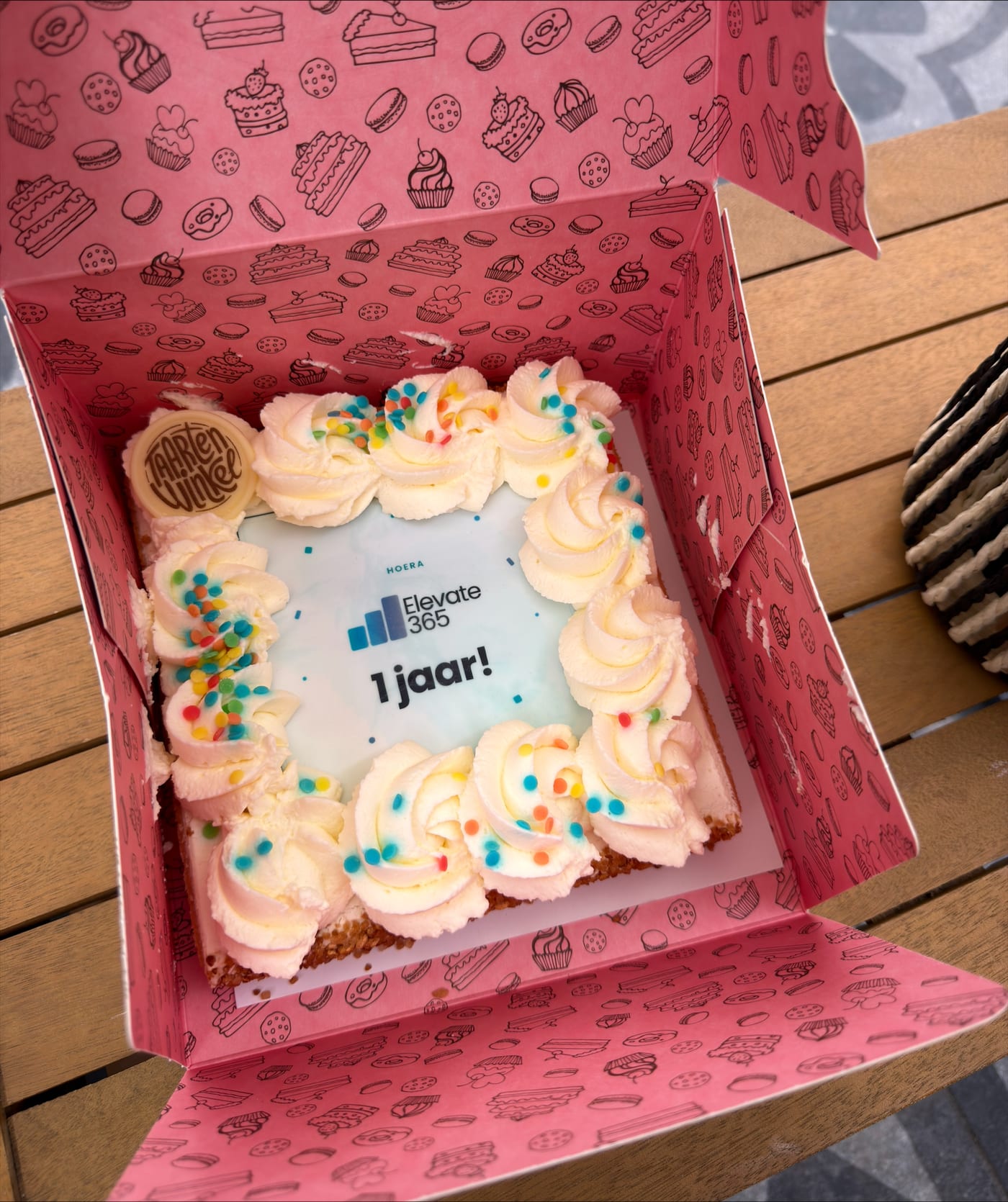
The question we asked ourselves a year ago was a big one: do we really dare to do this full time, together, with everything that comes with it? This week Elevate 365 as a B.V. turns one, and that is a good moment to look back on it honestly. Along with what the first year taught us about the way we want to work.
From one day a week to full time
Before the B.V. existed, things looked different. Elevate 365 started as a sole proprietorship that Frank spent one day a week on, alongside a part-time job. Safe, but half. You build something without really stepping into it.
A year ago, we made the call and went full time for ourselves, together. That was a big step. You give up the certainty of a fixed income and trade it for a mix of freelance work and our own projects, with no guarantee that the calendar stays full. In the first months you do the math more often than you would like: what is coming in, what is scheduled, will it hold.
It held. The clients came, the work was good, and the decision turned out to be the right one. It was exactly as big a step as it felt beforehand, and that is precisely why it is good, after a year, to see that we dared to take it. Giving up certainty and going all in together is a serious choice, and it is one we have not regretted for a moment.
SMB and enterprise: a different role, the same quality
We work for both SMB and enterprise organisations. The quality we deliver is the same everywhere. What varies quite a bit per environment is the role we take.
At an SMB client there is usually no in-house Power Platform team. So we handle the whole picture: from the first conversation about the problem to a working solution that goes into management. A project from start to finish, in which we set up the data model, build the app or the automation with Power Apps and Power Automate, and make sure it stays maintainable afterward. That is the work we get the most out of, because you have the full line in hand and can quickly deliver something a client actually uses.
At enterprise organisations it is different. There is often already a team, and we join because extra expertise or hands are needed. You build within existing frameworks, governance and agreements that someone else has set. That asks for something else: delivering your own part solidly and reliably within a larger whole, without breaking the team's line.
Honesty requires saying that both roles have their own pitfall. At SMB you are responsible for the foundation, and that is exactly where the temptation is strong to skip governance and management because it is "just a small app." That is precisely where it goes wrong later. In enterprise work the challenge is in fitting in: your solution has to be sound on its own and within the standards and management of a team you did not set up.
Two people decide better
The biggest difference from the sole proprietorship of the past is that we do it together. Frank leans more toward Power Platform and AI, from data model to build and pro-code. Marijn starts with the data, with Power BI and Power Apps. That overlap is there, but the angle differs enough to keep each other sharp.
In practice that mostly means one thing: you always have someone to run an approach past before you put it in front of a client. A quote, a data model, a choice between Dataverse and a lighter setup, it goes past the other first. Often nothing changes. Sometimes that second look pulls out an assumption you no longer saw yourself. A choice you cannot explain to your partner is usually not a choice you should be explaining to a client either.
That sounds obvious, but as a solo freelancer you miss exactly that. You confirm your own assumptions, because there is no one asking why you do something a certain way. With two people that question is built in.
What a year taught us about choosing
The most important skill we developed this year has little to do with technology: choosing which work you do and do not take on. As an employee your work is assigned to you. As an owner you decide it yourself, and that is less comfortable than it sounds. Every job you take on because it brings in money is time you are not spending on better-fitting work.
A few rules of thumb we picked up along the way
- Work that fits what we are good at almost always leads to a happier client than work we do "on the side."
- A client who wants quick results and is willing to lay the foundation properly is more valuable than a large project with an unclear scope.
- Saying no to the wrong job is uncomfortable in the short term and almost always the right choice in the longer term.
We have not regretted any of those choices. That is the result of deliberately steering toward work that fits.
On to the second year
A year on, there is something we are proud of: a business that runs, clients who come back and work we enjoy doing. The big step of last year is behind us, and what remains is the drive to keep building: on the way of working that fits, close to practice, with two people who keep each other sharp.
What has stayed with us most from this first year is that a big decision only proves itself in the work that comes after it. That work was good, and that is exactly what we did it for. On to the next year.